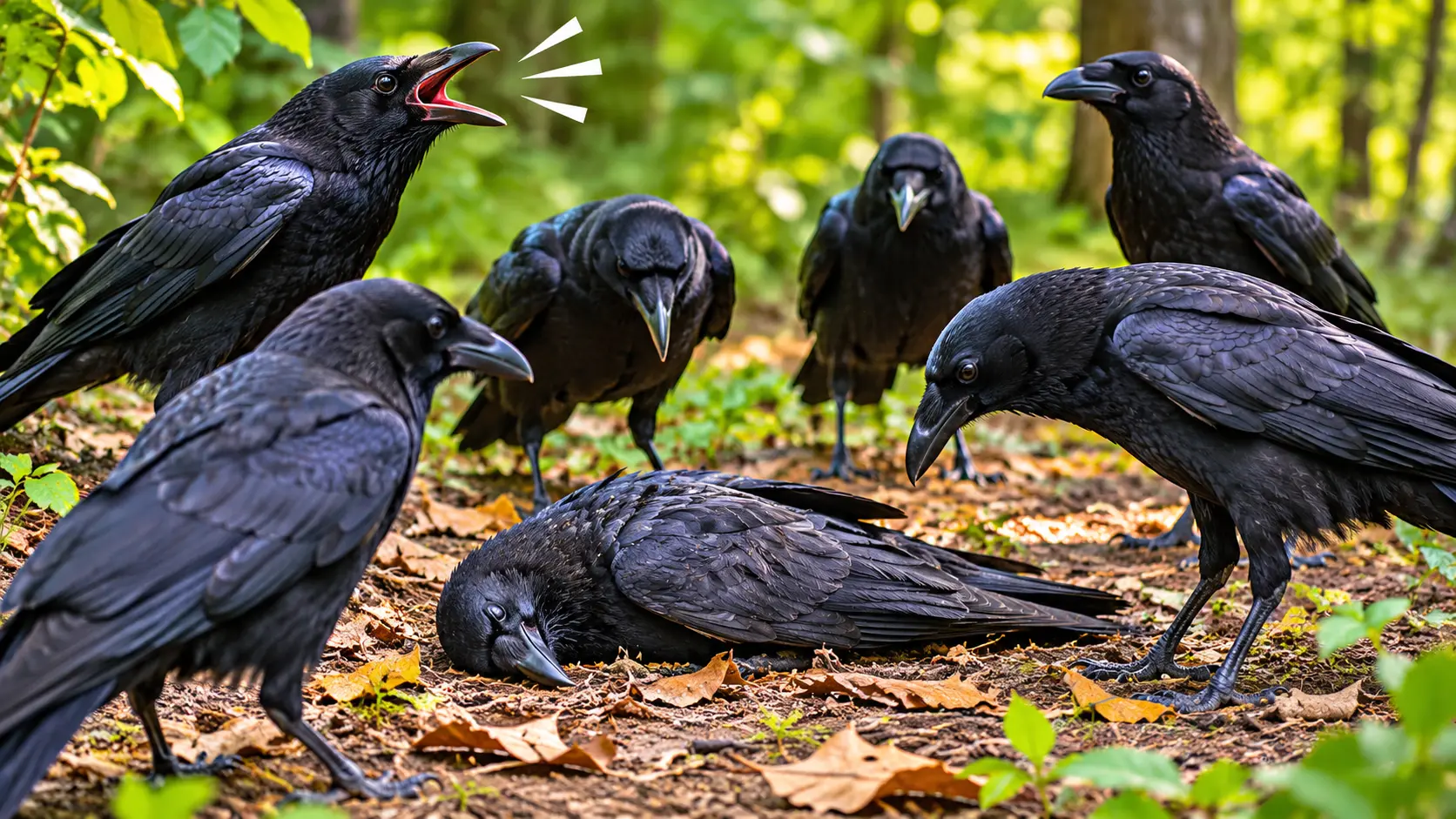
When a crow discovers another crow lying dead on the ground, something unusual can happen. Instead of quietly flying away, it may begin calling loudly, attracting other crows until several birds gather around the body.
The gathering can look remarkably like a funeral, especially when the birds remain nearby and repeatedly call to one another. However, scientific research suggests that these encounters may serve a different purpose, one connected to danger, learning and the remarkable social awareness of crows.
Researchers studying American crows have discovered that encounters with dead members of their species can influence how the surviving birds respond to unfamiliar people and potentially dangerous locations. The behavior offers a fascinating example of how animals use information from their surroundings to make decisions that may improve their chances of survival.
An Unusual Gathering
Crows are highly social birds that regularly communicate through vocalizations and body movements. Their interactions become particularly noticeable when something unfamiliar or potentially dangerous appears in their territory.
A dead crow can trigger a strong response from nearby birds, including repeated alarm calls and the arrival of additional crows. Some individuals may approach cautiously, while others remain perched on nearby branches, watching the situation.
These gatherings are sometimes described as crow funerals because they resemble the way humans assemble around a deceased individual. Although the comparison is memorable, scientists have not established that crows conduct funerals in the human sense.
The distinction matters because similar outward behavior does not necessarily reveal the same underlying motivation. A gathering that appears emotional to a human observer may also serve an important practical purpose for the animals involved.
Learning About Danger
One of the strongest scientific explanations for these gatherings involves the recognition of potential threats. A dead member of the same species can indicate that something dangerous has recently occurred in the surrounding environment.
For a living crow, this information may be valuable even when the cause of death is unknown. A predator, hazardous location, or unfamiliar threat could still be nearby, making additional caution potentially beneficial.
In 2015, researchers Kaeli Swift and John Marzluff published a study examining how wild American crows responded to dead crows and other potentially threatening situations. Their experiments demonstrated that the birds could learn to associate particular places and people with danger.
The findings suggest that gathering around a dead crow may involve more than immediate alarm. These encounters can influence subsequent behavior, allowing the surviving birds to respond differently when they encounter situations associated with previous threats.
What Researchers Discovered
The researchers conducted experiments involving wild American crows in the United States. They presented the birds with different situations, including a dead crow, a red-tailed hawk, and a hawk positioned with a dead crow.
These presentations allowed the researchers to compare the birds' responses to various signs of potential danger. The scientists observed alarm calling, mobbing behavior, and changes in how readily crows approached nearby food.
The presence of a hawk holding a dead crow produced particularly strong immediate defensive responses. This combination provided two important pieces of information: a potential predator and evidence that a crow had died.
The researchers also found that crows became more cautious about approaching food in locations associated with threatening encounters. Their behavior demonstrated that the experience could influence decisions beyond the moment when the apparent danger was visible.
These observations provide experimental support for the idea that dead crows can serve as meaningful warning signals. Rather than simply reacting to an unfamiliar object, the birds were able to associate certain circumstances with potential risk.
Remembering Human Faces
An especially interesting discovery involved the ability of crows to recognize people associated with threatening situations. In the experiments, researchers wore distinctive masks while presenting dead crows or other danger-related objects.
When those masked individuals appeared again, some crows responded with alarm calls and defensive behavior. This indicated that the birds could learn to associate the appearance of a particular person with an earlier threatening experience.
The researchers were not demonstrating that crows understood a human had killed the dead bird. Instead, the experiments showed that crows could identify and remember visual features associated with a potentially dangerous encounter.
This ability is especially useful for animals living in environments where threats may appear repeatedly. Remembering a dangerous individual or location can allow a bird to respond cautiously without having to experience the same danger again.
Crows are already known for their ability to recognize individual people under certain circumstances. Their responses to dead members of their species reveal another situation in which this remarkable learning ability becomes relevant.
Why Other Crows Arrive
When one crow begins making alarm calls, nearby birds may investigate the disturbance. Their arrival can produce the impression that the group has assembled specifically to observe the dead individual.
However, alarm calls can attract other crows even when the original threat is unrelated to death. Birds may respond because they recognize the calls as evidence that something unusual or dangerous is happening.
American crows are particularly well suited to this kind of social response because they frequently interact with relatives and neighboring birds. Many remain in family groups, and cooperation is an important feature of their social behavior.
The gathering may allow multiple birds to observe the same potential threat, although not every individual necessarily gains identical information. The presence of other crows can also contribute to collective defensive behavior when a predator is nearby.
These responses show why communication is important in crow societies. Information detected by one individual can quickly affect the behavior of several others in the surrounding area.
The Meaning of Mobbing
Mobbing occurs when birds gather around a perceived threat and attempt to drive it away through calls, close approaches, or other defensive actions. Crows sometimes mob hawks, owls, and other animals they consider dangerous.
A gathering around a dead crow may include similar alarm and recruitment behavior, even when no predator is immediately visible. The birds may respond to the dead crow as evidence of danger rather than as a target they intend to attack.
This distinction helps explain why loud calling and group activity are common during these encounters. The gathering may be part of a broader defensive response rather than a behavior reserved specifically for deceased birds.
Mobbing also carries potential risks because approaching a predator can expose birds to danger. Nevertheless, coordinated alarm behavior may help individuals monitor a threat and influence how other nearby birds respond.
The relationship between alarm calls and collective action demonstrates how crow behavior depends on both individual observations and interactions with other birds.
Not Every Dead Bird
A particularly revealing part of the research involved comparing reactions to different dead animals. Scientists wanted to know whether crows responded strongly to any dead bird or whether the identity of the deceased animal mattered.
In the 2015 experiments, dead pigeons did not produce the same consistent defensive responses as dead crows. This suggested that crows were especially sensitive to the death of members of their own species.
That difference is important because crows regularly encounter other dead animals while searching for food. American crows are opportunistic feeders that may consume carrion, although scavenging represents only part of their varied diet.
A dead crow may therefore convey information that an ordinary animal carcass does not. Its presence could indicate a threat capable of harming another crow, making it especially relevant to the surviving birds.
The findings also demonstrate why scientists compare different experimental conditions. Without testing the birds' responses to other dead animals, it would be much harder to determine what makes encounters with dead crows unusual.
Do Crows Feel Grief?
The possibility that crows experience grief is one of the most intriguing questions surrounding these gatherings. Their social relationships and strong reactions to dead companions naturally raise questions about whether emotion contributes to their behavior.
However, visible distress or prolonged attention does not automatically establish that an animal experiences grief in the same way humans describe it. Researchers must distinguish observable behavior from emotional states that cannot be directly measured.
Experiments with American crows provide strong evidence for danger recognition, learning, and defensive responses. They do not establish that every gathering is motivated by mourning or that crows understand death in a human-like way.
This does not mean emotions are absent from crow behavior. It means that current evidence supports certain explanations more directly than others, and conclusions about grief require additional investigation.
Recognizing this distinction makes the phenomenon more scientifically interesting. Crow gatherings are remarkable because of what researchers can demonstrate, not because the birds must be experiencing the same emotions as humans.
Do They Touch the Dead?
Another question concerns whether crows physically interact with dead members of their species. Observers occasionally report birds pecking, touching, or behaving unexpectedly around deceased individuals.
A 2018 study by Kaeli Swift and John Marzluff examined these interactions through controlled experiments. The researchers compared crow responses to dead crows with their reactions to other dead animals and lifelike crow models.
The study found that crows were generally more likely to produce alarm calls and recruit other birds than to make physical contact with dead crows. Touching was not a characteristic or consistently observed part of their response.
When physical interactions occurred, they varied considerably and sometimes involved aggressive or unusual behavior. The findings complicated the idea that crows routinely investigate their dead through direct contact.
The research also showed why an isolated wildlife observation cannot always explain an entire species' behavior. An unusual encounter may attract attention, but carefully controlled comparisons are needed to understand how representative that behavior really is.
How Long Do They Remember?
The ability to remember potentially dangerous experiences can have practical consequences for wildlife. A bird that associates a particular location with danger may approach it differently during future visits.
In the 2015 study, crows showed increased caution around food at locations associated with threatening encounters over subsequent days. They also demonstrated the ability to recognize people previously associated with danger.
These findings indicate that the response is not necessarily limited to the few minutes following the discovery of a dead crow. Information acquired during one encounter can influence behavior afterward.
The duration and strength of these memories depend on the circumstances and the type of information involved. Researchers have demonstrated impressive crow learning abilities, but this does not mean every threatening encounter produces a permanent memory.
What matters is that the birds can use previous experiences when evaluating their surroundings. This ability may help them avoid repeatedly exposing themselves to the same potentially dangerous situation.
A Window Into Intelligence
Crow intelligence is often discussed in connection with problem-solving, tool use, and memory. Their responses to dead companions reveal a different aspect of cognition involving the interpretation of potentially important events.
The birds do not need to identify the precise cause of death for an encounter to provide useful information. Recognizing that a location or individual is associated with danger may be enough to change their behavior.
This ability reflects the importance of learning in unpredictable environments. A crow cannot rely entirely on instinct when navigating towns, woodlands, roadsides, and other places where threats differ from one location to another.
Cognitive flexibility allows animals to adjust their actions as circumstances change. In crows, the combination of social communication, recognition, and experience-based learning provides several ways to respond to uncertain situations.
Their behavior offers a reminder that animal intelligence takes many forms. Understanding danger and responding to information from other individuals can be just as important as solving a visible puzzle.
What Observers Can Notice
Someone watching crows in a park or woodland may occasionally encounter a noisy gathering around an unusual object or animal. The behavior can involve repeated calling, birds arriving from different directions, and individuals watching from elevated positions.
These signs may indicate that the birds have detected a potential threat, but they do not necessarily mean a dead crow is present. Similar responses can occur when crows encounter predators or other disturbances.
The surrounding context can help explain what is happening. The presence of a hawk, the location of the gathering, and changes in the birds' behavior may provide useful clues about the situation.
Wildlife observers should avoid approaching occupied nests or deliberately disturbing the birds to provoke a reaction. Placing dead animals or artificial threats in an area is also unnecessary and can disrupt normal behavior.
Watching quietly from a safe distance allows natural interactions to continue with minimal interference. Careful observation often reveals more than attempting to make wildlife respond.
Understanding Crow Behavior
The familiar image of crows gathering around their dead contains a genuine biological mystery, but scientific research has already revealed part of the explanation. These encounters can involve threat recognition, alarm communication, memory, and changes in future behavior.
The strongest evidence comes from controlled studies showing that American crows respond to dead members of their species differently from certain other dead animals. They can also learn to associate people and locations with potentially dangerous experiences.
Although questions about grief and emotional awareness remain open, the established findings are remarkable in their own right. They show that a crow can use information about another bird's death to make decisions about its surrounding environment.
A noisy gathering of crows may therefore represent something more practical than a funeral and more complex than an ordinary alarm. It offers a glimpse into a social animal's ability to recognize danger, share warnings, and learn from events that affect other members of its species.