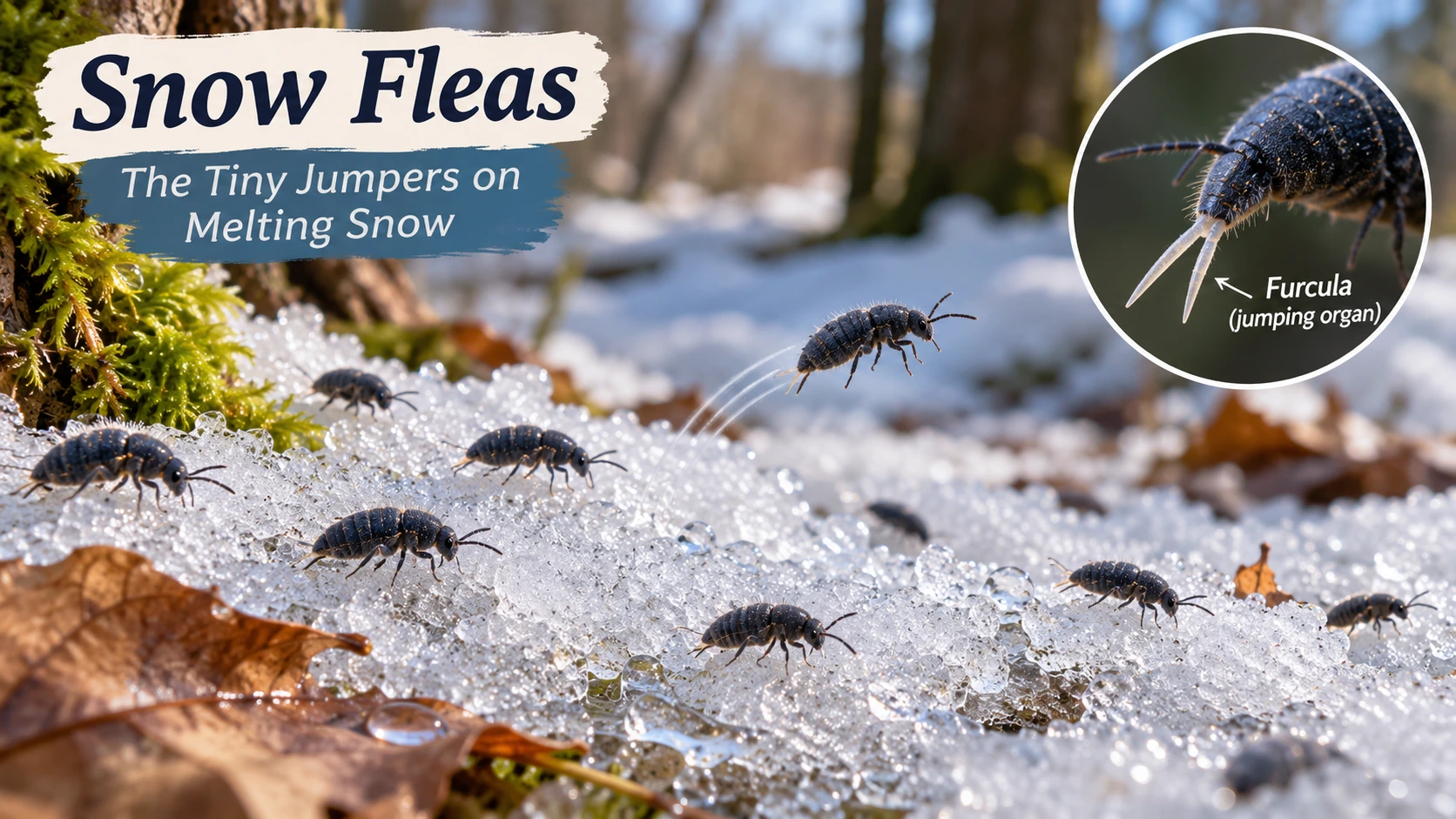
A patch of melting snow can sometimes appear to be covered in black pepper. Look more closely, however and those tiny dark specks may begin crawling across the surface or suddenly jumping into the air.
These creatures are often called snow fleas, although they are not actually fleas. Most of the tiny black animals seen gathering on snow in North America are springtails, a group of small, wingless arthropods that normally live among fallen leaves, damp soil and decaying vegetation.
Their appearance can seem especially strange when the surrounding landscape is still frozen. Yet these animals have not necessarily arrived from somewhere else, nor have they suddenly emerged from eggs laid in the snow.
They are part of a largely unnoticed community that remains present throughout the year. Winter thaws simply provide conditions in which some of its members become unusually easy to see.
Understanding why snow fleas appear reveals something unexpected about winter ecology. Beneath what looks like an inactive landscape, tiny animals continue feeding, moving, and interacting with their surroundings, sometimes using the snow itself as a temporary habitat.
Meet the Snow Fleas
The name snow flea is commonly applied to several cold-active springtails, including Hypogastrura nivicola, a species frequently encountered in North America. These animals are generally only a few millimeters long, with dark bodies that may look black, charcoal gray, or slightly bluish.
Their small size makes them difficult to distinguish from particles of soil or other debris. Against white snow, however, even a tiny individual becomes surprisingly noticeable.
Despite having six legs, springtails are generally classified separately from true insects. They belong to Collembola, a group of hexapods distinguished in part by their internal mouthparts and, in many species, a specialized structure used for jumping.
They also behave very differently from the familiar fleas that bite mammals. Springtails do not feed on blood, and their presence outdoors does not indicate that people, pets, or nearby wildlife are carrying parasites.
The University of Maine Cooperative Extension identifies Hypogastrura nivicola as one of the dark-colored springtails commonly seen gathering on snow. Its guidance also explains that springtails occupy a wide range of damp environments, including soil, leaf litter, rotting wood, and spaces beneath tree bark.
Not every springtail found around melting snow is black. The Maine Forest Service also describes a reddish species, Hypogastrura armata, that may gather around snowmelt pools and trails during spring thaws.
These differences are useful reminders that the term snow flea is a common name rather than a precise scientific identification. Several species can produce similar winter sightings, and identifying an individual to species level may require close examination.
Why They Suddenly Appear
Snow fleas spend much of their lives in places where people rarely notice them. Moist soil, decomposing leaves, moss, and the loose material covering a woodland floor provide both shelter and access to food.
During warmer months, their small bodies blend into these surroundings. A person can walk through an area containing large numbers of springtails without realizing that they are present.
Winter changes their visibility, particularly when temperatures rise enough to soften the snow. Some cold-adapted springtails move upward through openings in the snowpack and become active on the surface.
The University of Minnesota's snow flea guide describes this behavior in Hypogastrura nivicola, noting that the animals are often noticed near the bases of trees as snow begins melting. Their dark bodies stand out against the snow, sometimes making a large gathering look like a blackened patch.
This contrast helps explain why the animals may seem to appear overnight. A population that has remained almost invisible among soil particles and leaf litter becomes much easier to notice when individuals spread across a white surface.
Their movements are also influenced by local conditions rather than the calendar alone. A relatively mild period in the middle of winter may produce visible activity, while colder conditions can make the same area appear empty again.
Why One Patch Has Thousands
Snow fleas are not necessarily distributed evenly across a snowy landscape. Suitable habitats, moisture, local temperature, and the behavior of individual species can influence where large numbers become concentrated.
Some gatherings are especially noticeable in footprints and shallow depressions. These areas can collect moving springtails, creating dark clusters that appear much denser than the surrounding snow.
This effect was documented in an unusually detailed study of snow flea behavior published decades ago. The research showed that individuals sometimes accumulated temporarily in footprints and other small depressions from which they could not readily jump.
Consequently, a particularly dark patch does not automatically indicate that the snow beneath it contains more food or that the animals have chosen it as a permanent gathering place. Sometimes the shape of the snow itself helps explain the concentration.
Surviving the Cold
For such small animals, winter presents substantial challenges. Low temperatures can slow biological processes, while the formation of ice within body tissues can damage cells and interfere with normal functions.
Snow fleas are remarkable because certain species remain active under conditions that cause many other small arthropods to become inactive. Their ability to tolerate cold involves specialized physiology as well as the environmental protection available in their habitats.
One particularly important discovery came from research on Hypogastrura harveyi, another winter-active springtail. In 2005, scientists identified unusual proteins that help prevent the uncontrolled growth of ice crystals.
The original study published in Science described two glycine-rich antifreeze proteins isolated from this species. These proteins interact with ice, helping restrict crystal growth rather than functioning in exactly the same way as ordinary chemical antifreeze.
The finding provided a molecular explanation for an extraordinary survival adaptation. However, it would be incorrect to assume that every species called a snow flea possesses identical proteins or tolerates the same temperatures.
Later research examined how strongly these biological compounds could affect freezing. Laboratory measurements of extracts from H. harveyi showed freezing-point depression of approximately 5.8°C relative to the melting point under the tested conditions.
That figure describes an experimental property of the extracted material, not a universal temperature limit for living snow fleas. Actual survival depends on several factors, including the species, its physiological condition, and the surrounding environment.
Protection Beneath Snow
Biochemistry is only part of the explanation for winter survival. The environment beneath an accumulated layer of snow can be considerably less exposed to rapid temperature changes than the surface above it.
Snow contains spaces filled with air, which help reduce heat transfer between the ground and the colder atmosphere. This insulating effect can provide a more stable environment for organisms living in soil and leaf litter.
For springtails, such sheltered spaces may help reduce exposure to some of winter's harshest conditions. The amount of protection depends on snow depth, density, weather, and local ground conditions, so it should not be understood as a constant temperature beneath every snowbank.
These factors help explain why a forest floor can continue supporting life even when the air above it is extremely cold. Snow can be both a barrier separating small organisms from the surface and a protective layer moderating the conditions around them.
How Snow Fleas Jump
The name snow flea comes largely from an unusual movement that is easy to recognize once the animals are disturbed. A seemingly motionless speck may suddenly leap several centimeters, disappearing from its previous position almost instantly.
Unlike true fleas, which rely on powerful hind legs, many springtails possess a specialized appendage called a furcula. This forked structure is attached beneath the abdomen and remains folded forward when it is not being used.
A small retaining structure called the retinaculum helps hold the furcula in place. When the mechanism is released, the furcula extends rapidly and pushes against the surface, propelling the animal away from its starting position.
The movement is particularly impressive relative to the springtail's body size. An individual only a few millimeters long may travel several inches in a jump, although the distance varies with the animal and surrounding conditions.
Jumping can help springtails escape sudden disturbances, including potential predators. It also makes them surprisingly difficult to follow with the naked eye, especially when several individuals are moving across the snow at once.
The jumping mechanism is not unique to snow-active springtails. It is a characteristic adaptation found across many members of Collembola, although the exact structures and jumping abilities differ among species.
Their Strange Group Behavior
The large numbers seen on snow are fascinating, but snow flea behavior becomes even more interesting when the snow disappears. Under some conditions, springtails form dense groups that move across the forest floor rather than remaining in one location.
One of the most revealing investigations was conducted at Harvard Forest in Massachusetts during the early 1970s. Researcher Walter H. Lyford examined large colonies of Hypogastrura nivicola that appeared as moving dark patches among fallen leaves.
In a 1975 study published in The American Midland Naturalist, Lyford reported that some colonies approximately 30 centimeters across contained an estimated half-million to one million individuals. Their collective appearance resembled dark stains moving over the woodland floor.
The researcher followed colonies over time and found that some traveled substantial distances. One colony moved approximately 25 meters before disappearing, while others advanced several meters during a single day.
These were observations of colonies moving over the forest floor, not evidence that every large gathering on snow behaves in the same way. The distinction matters because the study also described springtails on snow as generally more widely spaced, although temporary concentrations occurred in depressions.
The movement appeared to have a strong relationship with daylight. Colonies stopped advancing at night, and experiments using dark coverings also interrupted their movement.
Exactly why these springtails sometimes form large traveling groups was not conclusively established by the study. Food availability, environmental conditions, and biological processes such as molting were among the possibilities considered.
This historical research adds an important perspective to an otherwise ordinary-looking winter sighting. The tiny animals scattered across melting snow belong to a group capable of surprisingly complex population-level behavior.
Snow Is a Habitat
Snow is often described as something that covers or conceals wildlife. For some cold-adapted springtails, however, its surface can become an environment where they actively move and interact with their surroundings.
This relationship has attracted scientific attention because snow does not remain in place throughout the year. It creates temporary conditions that vary with altitude, temperature, moisture, and the changing seasons.
A study published in 2024 examined snow-active springtails in Italy's Adamello-Brenta Nature Park. Researchers investigated gatherings on snow over a 17-month sampling period, identifying five springtail species among the populations studied.
The findings included three forms considered potentially new to science, although further taxonomic work would be needed to establish their status. This was a reminder that even conspicuous animal gatherings can contain poorly understood biodiversity.
The researchers also explored the possibility that snow acts as a temporary ecological corridor. In some landscapes, the snow surface may allow cold-adapted springtails to move between suitable areas that would otherwise be more difficult to cross.
The 2024 research in Rendiconti Lincei described snow as a potentially important seasonal habitat while recognizing that its ecological role requires further investigation. The proposed corridor function is an interpretation supported by observations, not a proven explanation for every springtail movement.
These findings raise interesting questions about how changing snow conditions might affect specialized winter-active organisms. Shorter periods of snow cover, altered melting patterns, and changing winter temperatures could modify the environments available to them.
The effects are unlikely to be identical across all springtail species or regions. Understanding those differences requires observations over time rather than assuming that every winter thaw is beneficial or harmful.
Why Forests Need Them
Snow fleas attract attention when they appear on white snow, but their ecological importance extends beyond those brief winter sightings. Much of their activity occurs within the community of organisms responsible for processing dead plant material.
Forest floors constantly receive fallen leaves, twigs, fragments of bark, and other organic matter. Fungi and bacteria play central roles in breaking down this material, while small animals such as springtails participate through their feeding activities.
Many springtails consume fungi, algae, microorganisms, or organic material associated with decomposition. By interacting with these resources, they can influence microbial communities and the movement of nutrients through soil ecosystems.
Their effects are not always identical or uniformly beneficial. Depending on the species and environmental conditions, grazing can stimulate some fungal processes or reduce the abundance and activity of particular fungi.
This complexity makes springtails important participants in soil food webs rather than simple waste removers. Their ecological role comes from relationships with microorganisms, organic material, and other animals sharing the same habitat.
The University of Maine Cooperative Extension's springtail information describes their contribution to decomposition and explains why they are generally regarded as beneficial organisms outdoors.
A gathering on melting snow therefore represents more than an unusual seasonal curiosity. It reveals animals connected to biological processes that continue shaping the forest floor long after the snow has disappeared.
Britain's Other Snow Flea
The name snow flea creates an unexpected complication for readers in Britain. Although North Americans commonly use it for cold-active springtails, the name is also applied to a completely different animal found in British habitats.
This animal is Boreus hyemalis, a small flightless insect belonging to Mecoptera, the order that includes scorpionflies. It is not a springtail and has a different body structure and evolutionary history.
Adults are generally around 3–5 millimeters long and may be found among moss in woodlands, heathlands, and other suitable habitats. They are active during colder parts of the year and can occasionally be seen crawling or jumping across snow.
One of their most recognizable features is a long, downward-projecting, beak-like head. Their legs are also relatively long, giving them a noticeably different appearance from the compact springtails commonly associated with black specks on North American snow.
According to The Wildlife Trusts' species guide, adult Boreus hyemalis can be encountered from October through April. The guide also describes their reduced wings and unusual ability to move through mossy habitats during winter.
The difference is more than a technical detail. Two animals can share a familiar name because they display similar behavior without belonging to the same biological group.
This does not mean that springtails are absent from Britain. Many springtail species live in British habitats, so location alone cannot establish whether a tiny animal on snow is Boreus hyemalis or a member of Collembola.
For anyone trying to identify a winter sighting, examining the animal's body shape is therefore more reliable than depending entirely on its common name.
Recognizing Them Safely
If dark specks appear across melting snow, movement is the most useful place to begin an identification. Soil particles, soot, and fragments of vegetation can look remarkably similar from a distance, but they will not deliberately crawl or jump.
Watching a small area without disturbing it may reveal individual animals moving between snow crystals. A hand lens or smartphone capable of close-up photography can make their body structure easier to examine.
Springtails commonly appear as tiny, dark, wingless animals with antennae and six legs. Their characteristic jumping behavior provides another clue, although not every individual will jump during a brief observation.
The surrounding environment can also be informative. Snow-covered woodland paths, areas near tree trunks, damp leaf litter, and melting snowbanks are reasonable places to look for snow-active springtails.
Care is still necessary when identifying an unfamiliar animal from a photograph. Several small arthropods can resemble one another, and a species-level identification may require anatomical details that are difficult to capture without specialized equipment.
Are Snow Fleas Harmful?
The springtails commonly called snow fleas in North America are harmless to people and pets. They do not bite, feed on blood, or establish the parasitic infestations associated with true fleas.
Their appearance on snow is a normal natural occurrence that generally requires no intervention. Even large outdoor gatherings are usually temporary, with the visible numbers changing as moisture and temperature conditions shift.
Springtails can occasionally become noticeable inside homes, particularly around damp basements, bathrooms, or overwatered houseplants. Such situations are usually associated with moisture rather than an outdoor snow flea population attempting to infest a building.
The University of New Hampshire Extension recommends addressing sources of excess moisture when springtails become troublesome indoors. Correcting leaks, improving ventilation, and reducing persistent dampness are generally more useful than applying insecticides.
For outdoor sightings, observation is usually the best response. There is no reason to spray the snow or remove these animals simply because their numbers make the surface look unusual.
What Their Appearance Means
Snow fleas are often associated with late winter and the approach of spring, but their appearance should not be treated as a dependable forecast. A brief period of mild weather can support activity even when colder conditions are likely to return.
Their presence tells us more about the immediate environment than about the weather several weeks ahead. Moisture, snow conditions, temperature, and the biology of the particular species all influence when they become visible.
What makes them remarkable is not that they predict seasonal change, but that they reveal biological activity in a place many people assume is almost lifeless.
A dark patch of snow may contain hundreds or thousands of small animals that have spent much of the year hidden among soil and fallen leaves. Some possess specialized cold-survival mechanisms, others belong to species still poorly understood, and many participate in the processes that maintain life beneath the forest floor.
The next time tiny black specks appear on melting snow, a closer look may reveal far more than an unusual winter curiosity. It may offer a brief view into a living world that continues functioning even when the landscape above it appears frozen.