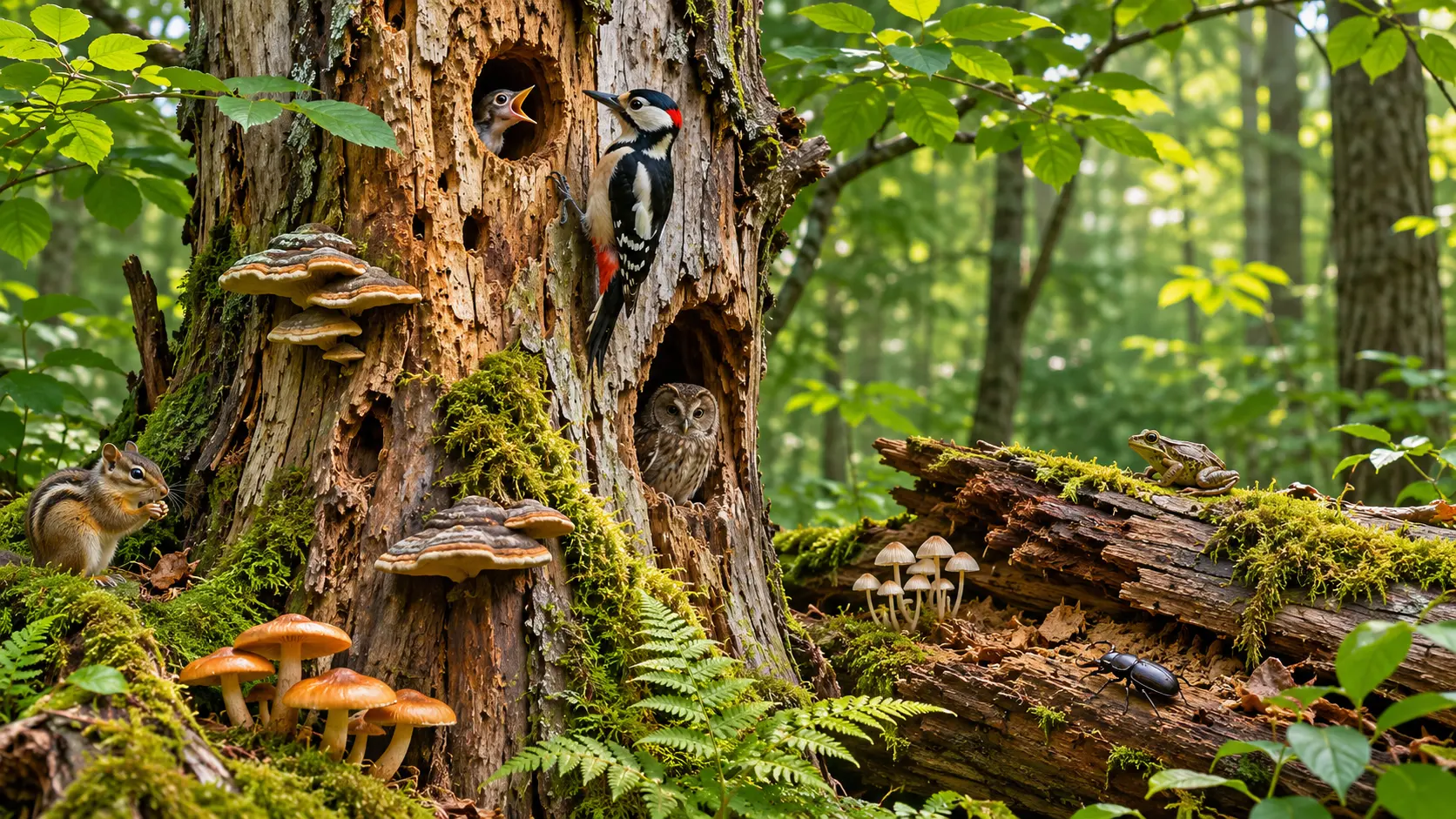
A dead tree may appear lifeless, but its role in the forest is far from finished. Beneath its peeling bark, inside its hollow trunk and around its decaying roots, an extraordinary community of organisms can continue to thrive long after the tree stops growing.
Woodpeckers excavate nesting cavities, beetles tunnel through softening wood and fungi gradually break down the remaining structure. These activities reveal an overlooked part of forest ecology, where the death of one organism creates opportunities for many others.
Life After Death
When a tree dies, it begins a gradual transformation rather than immediately losing its ecological value. Its leaves disappear, branches weaken and internal tissues slowly decompose, creating new conditions for organisms that depend on dead or dying wood.
Standing dead trees, known as snags, are particularly valuable because they retain much of their original height and structure. Their trunks can provide nesting cavities, while exposed branches offer perching sites for birds searching for food or watching for predators.
The ecological role of a dead tree continues to evolve as its condition changes. Recently dead wood may attract certain insects, while older, softer material can support different organisms that require more advanced stages of decomposition.
A Home for Wildlife
Dead trees provide shelter for numerous forest animals, including birds, mammals, insects, and other organisms. Natural cracks, hollow branches, and cavities offer protected spaces that may be difficult to find elsewhere in the surrounding woodland.
Woodpeckers are especially important because many species excavate cavities in trees for nesting. Once these birds abandon their nesting sites, the openings may become available to animals that cannot create suitable cavities themselves.
Chickadees, nuthatches, certain owls, and flying squirrels are among the animals that may use existing tree cavities. The suitability of each opening depends on factors such as its size, height, location, and surrounding habitat.
For some wildlife species, these cavities are essential breeding resources rather than simply convenient shelters. A woodland containing mature trees and standing deadwood can therefore provide nesting opportunities that a young forest may lack.
Beneath the Bark
The space beneath a dead tree's bark can support an active community of insects and other small organisms. Beetles, larvae, and various wood-associated invertebrates occupy different parts of the trunk as the wood gradually changes.
Some insects feed directly on wood or fungi, while others prey on organisms already living inside the tree. These feeding relationships create a complicated ecological network that may remain largely invisible to someone walking through the forest.
The insects also become food for birds and other predators. Woodpeckers, for example, can detect and extract insects from beneath bark or within decaying wood, turning a seemingly lifeless trunk into a valuable feeding location.
Not every insect inhabits the same type of deadwood or appears at the same stage of decomposition. Some species prefer recently dead trees with intact bark, while others depend on wood that has softened and developed fungal growth.
Fungi at Work
Fungi are among the most important organisms involved in the decomposition of dead trees. Many wood-decaying species produce enzymes that break down cellulose, lignin, and other structural materials, gradually altering the physical condition of the wood.
Visible mushrooms and shelf-like fungal growths are only part of this process. Much of the activity occurs inside the tree, where networks of fungal filaments spread through the wood and obtain nutrients from the material they decompose.
As fungal decay progresses, the trunk may become softer, more porous, and increasingly fragmented. These changes create conditions that allow different insects, microorganisms, and other organisms to occupy the developing habitat.
Decomposition also contributes to nutrient cycling within the forest. Nutrients held in the dead tree gradually move into surrounding ecological systems, although the process can take many years depending on the tree species and local environmental conditions.
When Trees Fall
A standing dead tree eventually may collapse, beginning another phase of its ecological contribution. Once the trunk reaches the forest floor, it becomes part of an environment where moisture, soil contact, and shade influence the organisms that inhabit it.
Fallen logs can create damp spaces beneath their surfaces and provide shelter from direct sunlight and drying winds. Such conditions may benefit woodland invertebrates, mosses, fungi, and certain amphibians that depend on moist environments.
As the wood decomposes, its ability to retain moisture and support plant growth may change. In some forests, fallen trunks become suitable places for seeds to germinate and young plants to establish themselves.
These structures are sometimes known as nurse logs because they can support new vegetation. Their effectiveness depends on factors including the surrounding climate, available seeds, wood condition, and competition from other plants.
Decay Creates Diversity
A dead tree does not provide the same habitat throughout its entire period of decomposition. Its ecological characteristics change as bark loosens, wood softens, cavities develop, and fungi alter its internal structure.
These changes allow different organisms to use the tree at different times. Species that depend on hard, recently dead wood may disappear from an older log, while organisms adapted to softer, decomposed material become more common.
The size and species of the original tree also influence the habitats that develop. Large trunks may remain structurally intact for extended periods, providing shelter and feeding opportunities that smaller branches cannot offer.
A forest containing standing snags, fallen trunks, decaying branches, and wood at various stages of decomposition can support a wider range of deadwood habitats. This variety is particularly important for species with specialized ecological requirements.
The Role of Woodpeckers
Woodpeckers demonstrate how the activities of one animal can influence an entire community. By excavating cavities and searching for insects within trees, these birds modify habitats in ways that can benefit other wildlife.
Their strong bills allow them to penetrate wood, while specialized anatomical features help them obtain food from difficult-to-reach spaces. Different woodpecker species vary in their feeding behavior, nesting preferences, and dependence on dead or weakened trees.
The cavities they create can remain useful after the original occupants leave. Some may provide nesting locations for other birds, while suitable openings can also shelter small mammals and other cavity-using animals.
This ecological contribution makes woodpeckers important habitat creators in many forest systems. Their presence can influence which other species find suitable shelter, especially where natural nesting cavities are limited.
What Forests Lose
Removing dead trees and fallen wood can make a woodland appear cleaner, but it may also reduce the habitats available to wildlife. Organisms that rely on decomposing wood cannot always survive in areas containing only healthy, living trees.
The loss of suitable deadwood can affect insects, fungi, cavity-nesting birds, and other animals with specialized requirements. These effects may extend through the food web when predators lose access to organisms that once lived within the wood.
Forest management must nevertheless consider public safety and environmental risks. Dead trees near roads, buildings, walking trails, or frequently used recreational areas may present hazards, while local fire conditions and forest diseases can require additional precautions.
Conservation decisions therefore involve balancing ecological benefits with practical management responsibilities. Retaining appropriate deadwood in suitable locations can help preserve biodiversity without overlooking legitimate safety concerns.
Signs of Hidden Life
A woodland walk can reveal several clues that a dead tree is supporting wildlife. Small openings in the trunk, peeling bark, fungal growths, and areas of softened wood may indicate that different organisms are using the tree.
Woodpecker cavities are particularly interesting because they show how animals can physically modify their surroundings. These openings may later become nesting or sheltering spaces for other species, depending on their location and condition.
Fallen logs covered with moss or partially embedded in the forest floor can also reveal stages of decomposition. Moisture, fungal activity, and soil contact gradually influence the structure of the wood and the communities developing around it.
Observing these habitats does not require disturbing them. Dead trees can be structurally unstable, and breaking apart decaying logs or investigating occupied cavities may damage the organisms and shelters that make them ecologically important.
A Complete Forest
A healthy forest contains more than vigorous trees, green leaves, and new growth. Its ecological functioning also depends on decomposition, nutrient cycling, habitat formation, and the gradual transformation of older vegetation.
Deadwood contributes to these processes by supporting specialized organisms and providing physical structures that living trees may not offer. Some wildlife species depend on particular types of decaying wood that cannot be replaced simply by planting additional trees.
The amount and diversity of deadwood can therefore be meaningful considerations in forest conservation. Mature trees, standing snags, fallen logs, and naturally decomposing material each contribute different features to the surrounding habitat.
Protecting biodiversity requires an understanding of these relationships rather than judging woodland health entirely by appearance. A forest with fallen trunks and weathered standing trees may contain valuable habitats that are easily overlooked.
Nature's Continuing Cycle
The death of a tree does not mark the end of its contribution to the forest. Its remaining wood can provide nesting places, shelter developing insects, support fungal communities, and gradually return nutrients to the surrounding environment.
These changes occur over different timescales, with organisms arriving and disappearing as the tree moves through successive stages of decomposition. What begins as a standing trunk may eventually become a fragment of the forest floor, supporting ecological processes throughout its transformation.
The next time a dead tree appears along a woodland trail, its weathered surface may deserve a closer look from a safe distance. Behind that quiet exterior lies a continuing story of habitat creation, decomposition, and the interconnected lives of forest organisms.